Your free guide
Why it still burns: your free guide
Thank you for downloading this guide. If your mouth burns and every test has come back normal, this is written for you. Take your time with it. You can come back to this page whenever you need it.
By Adam Cox, clinical hypnotherapist. About 15 minutes to read.

This guide is information, not medical advice. Please make sure your dentist or GP has checked for other causes of a burning mouth, and keep taking any prescribed treatment.
1. The burning is real
Let’s start with the most important thing. The burning you feel is real. You are not imagining it, exaggerating it or making it up.
Burning mouth syndrome is a recognised pain condition. It is diagnosed when the mouth looks healthy, tests are normal, and the burning keeps coming back for months. That is not a sign that nothing is wrong. It is a sign that the problem is not in the tissue of your mouth.
2. Pain is made in the brain
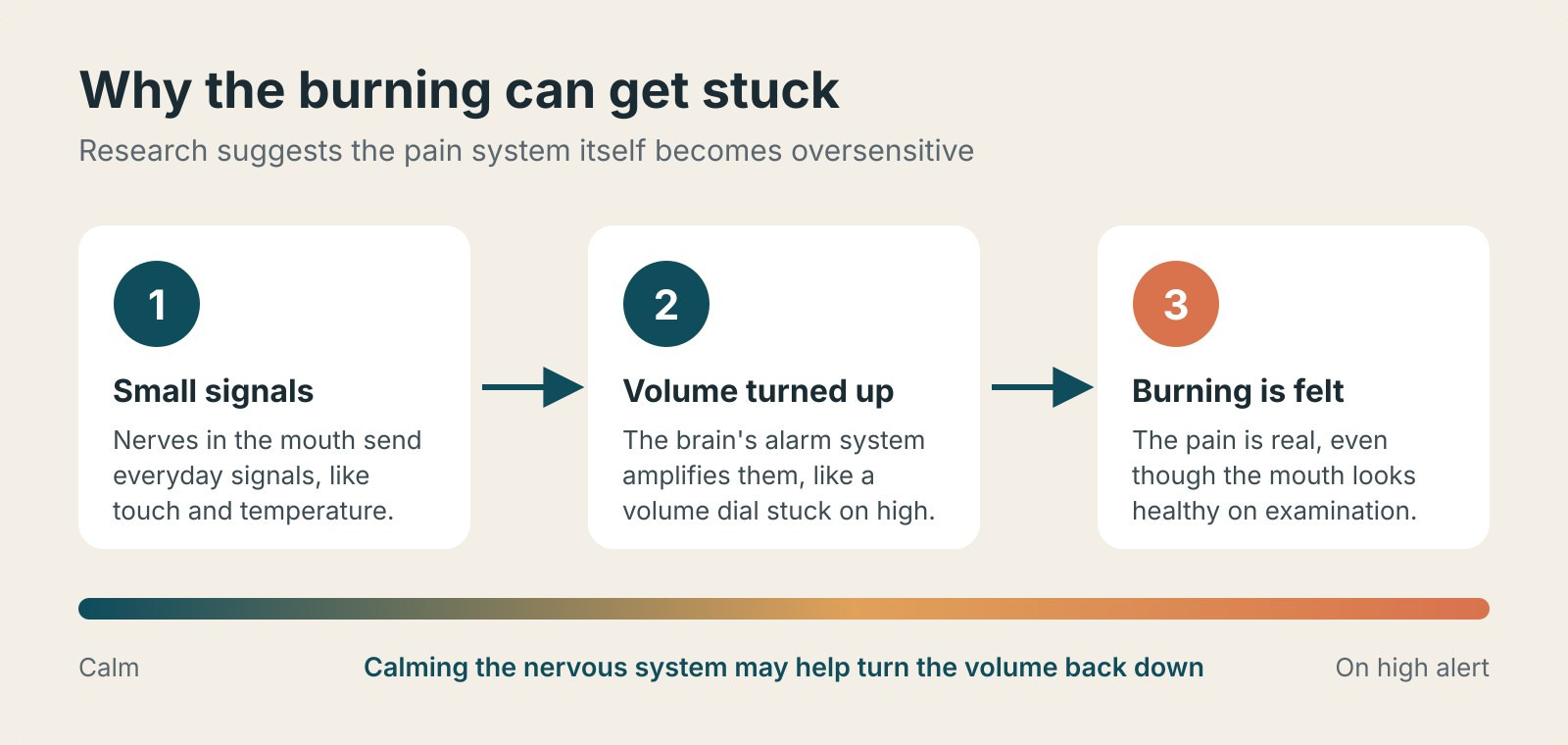
Every pain you have ever felt was produced by your brain. When you burn your tongue on hot tea, nerves send signals to the brain, and the brain decides whether to create the feeling of pain.
Normally the alarm switches off when the danger has passed. Sometimes the system becomes oversensitive and keeps sounding the alarm when there is no danger, like a smoke alarm that goes off every time someone makes toast.
Researchers now describe burning mouth syndrome as this kind of pain. It is called nociplastic pain, and brain scan studies show changes in the parts of the brain that process pain.
3. What phantom limb pain teaches us
People who lose an arm or leg can still feel it. Many feel itching, cramp or burning in a hand or foot that is no longer there. There is nothing in that place to injure, and yet the feeling is completely real. It comes from the brain’s map of the body.
Your tongue is healthy, but the brain’s map of your mouth may be sending a burning signal. That is why tests come back normal, and why the burning is still real.
4. Why it is worse on some days
The brain sets the volume of pain using everything it knows, including how safe or threatened you feel. These things often turn the volume up:
- stress and worry
- poor sleep and tiredness
- the evening, after a long day
- hot, spicy or acidic food and drink
- alcohol
- focusing on the burning and checking it
And these often turn it down:
- feeling safe and relaxed
- being absorbed in something you enjoy
- good sleep
- cool drinks and ice chips
Noticing your own pattern is one of the most useful things you can do. Try scoring the burning from 0 to 10 three times a day for a week, and jot down what was happening.

5. Simple steps for the next seven days
- Sip cold water through the day and try sucking ice chips when it flares.
- Switch to a mild, flavour-free toothpaste and an alcohol-free mouthwash.
- Cut down on spicy, acidic and very hot food and drink, and on cinnamon and mint flavours.
- Listen to the free relaxation session once a day, somewhere comfortable, never while driving.
- Each time you notice the burning, take three slow breaths and let your jaw and shoulders drop.
6. If you are leaning on painkillers or a drink
Many people do, and there is no judgement here. Painkillers often help less than expected with this kind of pain, and alcohol can irritate the mouth and disturb sleep. Always follow the dose on the packet. If you drink every day and want to stop, talk to your GP first, as stopping suddenly can be risky.
7. Questions to take to your dentist or GP
- Have thrush, dry mouth and denture problems been ruled out?
- Have I had blood tests for iron, B12, folate, zinc, blood sugar and thyroid?
- Could any of my medicines be playing a part?
- Could reflux be involved?
- Can I be referred to an oral medicine specialist?
- Is talking therapy, such as CBT, available to me?

8. There is reason for hope
If the burning comes from a nervous system that has become oversensitive, then helping that system feel safe again is a sensible thing to work on. The nervous system can learn, and it can also unlearn.
That is the thinking behind psychological approaches to chronic pain. CBT has research support for burning mouth syndrome. Hypnotherapy has research support for chronic pain more widely, and many people find it helps them feel calmer and more in control. It has not yet been tested in a trial for BMS specifically, and results vary from person to person.
What next: The Quiet Fire Programme
Over the next few days I’ll send you a few short emails with more ideas you can use. If you would like more support, The Quiet Fire Programme is how I work with people with burning mouth syndrome, alongside their dentist or GP.
It brings together a self-paced course of 12 short lessons and five one-to-one sessions with me. Inside, you will:
- understand how your brain turns signals into burning, and find what turns it up and down
- practise a daily self-hypnosis recording designed to help your nervous system settle
- ease the worry, frustration and tiredness that build up around long-term pain
- find other ways through hard days, so you rely less on painkillers or a drink
- leave with your own one-page plan for flare-ups
The first step is a consultation call. We talk through your symptoms, what you have tried and whether the programme suits you. The call is £49 (US $59), and the fee comes off the programme if you join. Everyone is different and no result can be promised, but many people find that having a plan, and someone in their corner, makes a real difference.